Maca root for blood sugar and stamina: the Glyvoryn ingredient guide

Updated September 2026 · reviewed by the Glyvoryn Research Team. We are an independent information resource, not a medical provider, and this article is educational rather than medical advice.
Maca root for blood sugar is best understood as a supporting player rather than a star: maca (Lepidium meyenii) is a Peruvian root vegetable prized for centuries for stamina and everyday vitality, and in Glyvoryn it sits inside a 200 mg botanical blend that rounds out a chromium mineral base. Its job in the formula is steadier daily energy and general wellness, not the blood-sugar-lowering role people sometimes assume — and knowing that distinction is the whole point of this guide. Maca's human evidence sits in performance and fatigue rather than glucose: a double-blind crossover study examined maca supplementation, performance and antifatigue ability (Wu et al., Journal of Physiological Investigation, 2025).
What maca actually does in Glyvoryn, honestly.
- What maca is
- A cruciferous Andean root, Lepidium meyenii, eaten as a food for thousands of years and used traditionally for stamina and vitality.
- Its role here
- In Glyvoryn, maca is one of five botanicals in a 200 mg blend — a vitality and stamina partner, not the blood-sugar lever.
- Blood-sugar evidence
- Direct human glucose data for maca is limited and preliminary; the mineral base and other botanicals carry the blood-sugar story.
- Not a stimulant
- Maca contains no caffeine, so its reputation is for even, non-jittery energy rather than a spike-and-crash lift.
Maca has ridden a wave of wellness popularity, and with it some hype. Our aim is to separate what tradition and research support from what gets over-promised, and show where the maca in Glyvoryn fits. For the broader picture, see our overview of how to support healthy blood sugar naturally. For blood sugar specifically, an overview of meta-analyses of medicinal plants for glycaemic control is the place to check whether a plant has earned the claim (Willcox et al., Frontiers in Pharmacology, 2021).
What is maca root, exactly?
Maca root is the edible tuber of Lepidium meyenii, a hardy cruciferous plant that grows on the high Andean plateaus of Peru, above 4,000 metres where few crops survive. For at least two thousand years Andean communities have dried, roasted and cooked maca as a staple food, and it remains a normal part of the diet in its home region today. In supplements it is milled into a powder, which is what a formula like Glyvoryn concentrates rather than the fresh vegetable.
Botanically, maca is a relative of broccoli, cabbage and radish, and it comes in several colours — yellow, red and black. Its long culinary history is one reason it carries a reassuring safety record: this is not an exotic isolate but a vegetable people have eaten for millennia.
What is maca root traditionally used for?
Maca root is traditionally used to support stamina, endurance and a general sense of everyday vitality — the qualities that made it valuable to people living at extreme altitude. Andean tradition reached for maca as a strengthening food, and that reputation for steady energy and resilience carried it into the modern supplement aisle.
Stamina and everyday energy
The headline traditional use for maca is stamina. Because maca contains no caffeine, the energy it is associated with is described as even and sustained rather than the lift and crash of a stimulant. In a daily formula that is useful: you want a steadier baseline, not a jittery peak and slump. The same traditional-use caveat applies to astragalus root in this blend. What a proprietary blend is permitted to disclose is a regulatory matter, summarised in an overview of United States supplement regulation (Brown, Food and Chemical Toxicology, 2017).
Vitality, mood and resilience
Maca is often grouped with adaptogens — foods and herbs traditionally used to help the body cope with everyday demands. Small early studies have explored maca for mood and well-being, but the research is preliminary and mixed, so the honest framing is traditional use and promising-but-unsettled evidence, not proof of any specific effect.
Does maca root help blood sugar?
Maca root is not a blood-sugar-lowering agent, and the direct human evidence for a glucose effect is limited and preliminary. Some lab and animal work has looked at maca’s antioxidant and metabolic properties, and its fibre and nutrient profile fits a healthy diet, but there is no strong clinical basis for claiming maca lowers blood sugar in people. Being upfront about that matters more than a marketing headline.
So why is maca in a blood-sugar formula at all? Because Glyvoryn is built around two everyday goals, not one, and a blood-sugar supplement that leaves you feeling flat has missed half the point. Maca’s stamina and vitality role complements the ingredients that carry the blood-sugar story — chromium for normal macronutrient metabolism, gymnema for its long history in blood-sugar wellness. Maca is the vitality partner in that pairing.
See the exact dose in Glyvoryn →
How does maca fit Glyvoryn’s 200 mg blend?
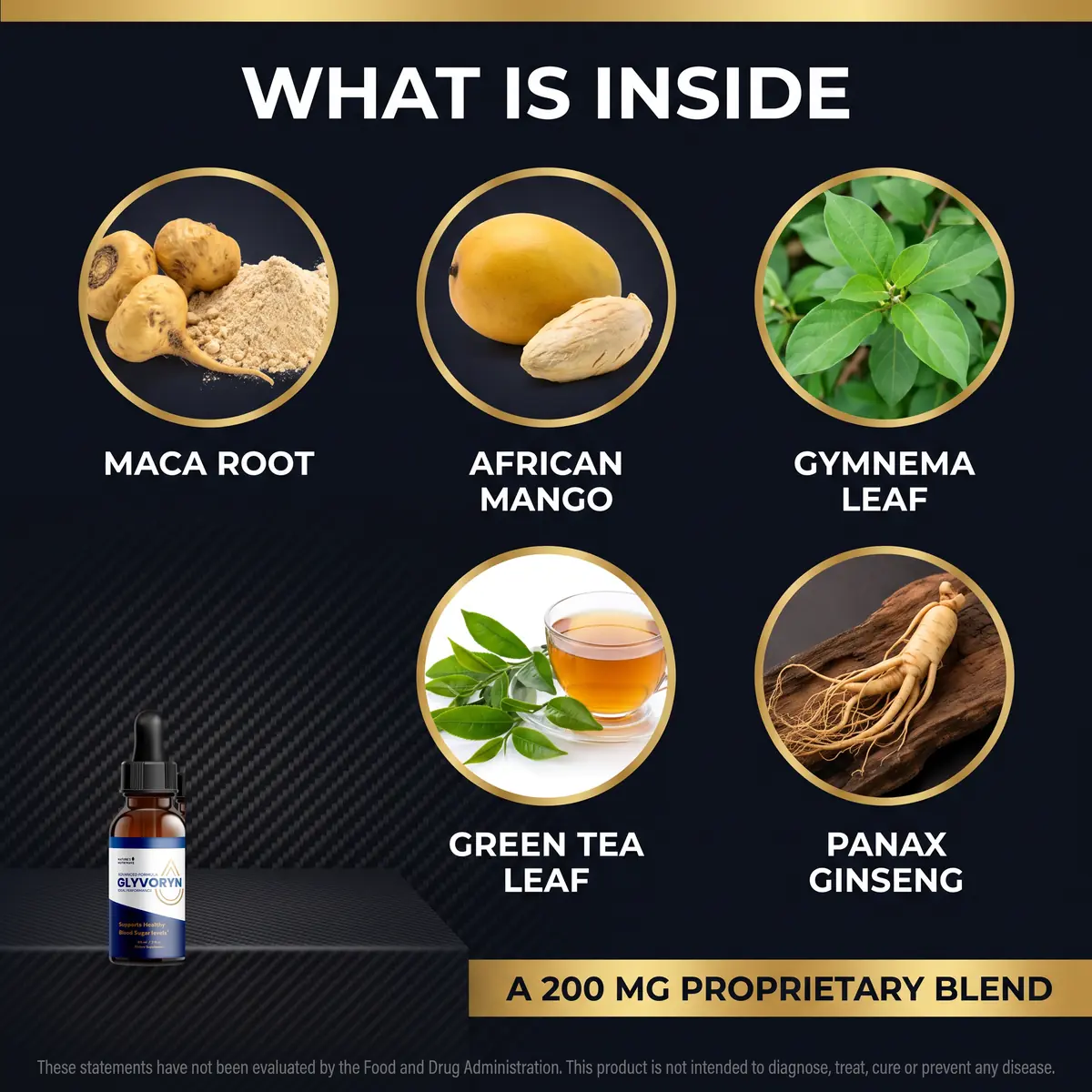
In Glyvoryn, maca is one of five botanicals sharing a single 200 mg proprietary blend, delivered as fast liquid drops and paired with a chromium mineral base. Rather than dosing each herb alone, the formula groups them so their roles overlap: some lean toward blood-sugar wellness, others toward stamina and energy. The table below shows where maca sits.
| Botanical | Traditional lean | What it contributes to the blend |
|---|---|---|
| Maca (Lepidium meyenii) | Stamina & vitality | The everyday-energy partner; a caffeine-free Andean food root used traditionally for endurance. |
| Gymnema | Blood-sugar wellness | Known as gurmar, “sugar destroyer”; one of the most researched herbs for everyday glucose support. |
| African mango | Fibre & metabolism | A fibre-rich West African seed popular in metabolism-focused formulas. |
| Green tea | Antioxidant support | A rich natural source of polyphenol antioxidants, widely studied for general metabolic wellness. |
| Panax ginseng | Energy & resilience | A storied adaptogen tonic used to support stamina and everyday vitality — a natural companion to maca. |
Alongside this 200 mg blend, Glyvoryn provides chromium (as chromium picolinate), an essential trace mineral that contributes to normal macronutrient metabolism. That mineral base is the formula’s blood-sugar-wellness anchor; maca and panax ginseng are its stamina anchors. For a closer look at the mineral side, read our companion guide to chromium and gymnema for blood sugar.


Maca, chromium and more in one dropper
Glyvoryn is a once-daily liquid pairing chromium with a 200 mg botanical blend of maca, gymnema, African mango, green tea and panax ginseng. The six-bottle bundle is the best value at $49 per bottle, with free U.S. shipping and a 60-day guarantee.
Check today’s Glyvoryn pricing — from $49/bottleHow is maca root used and dosed?
Maca root is typically taken daily as a dried powder, and consistency matters more than any single large dose. Traditional food use spans grams of dried root, while supplements use smaller amounts within a wider formula, which is how maca appears in Glyvoryn: blended, not dosed alone.
Why liquid drops instead of a capsule?
Glyvoryn delivers its maca-and-mineral formula as a liquid dropper you hold briefly under the tongue before swallowing. For a once-daily routine that is convenient: no pill, easy to add to a morning glass of water, simple to keep at the same time each day. A supplement works best when you remember to take it, and a quick dropper lowers that friction.
What to expect, and over what timeframe
Botanicals like maca build their support gradually rather than delivering an instant hit, so most people give a blend several weeks before judging how it fits their routine. This is a daily-wellness habit, not a stimulant you feel within minutes. Because of that gradual arc, many choose a multi-month supply — compare the packages and pricing on the homepage.
| Question | Honest answer |
|---|---|
| Is maca a stimulant? | No — it contains no caffeine; its reputation is for even, non-jittery energy. |
| Does maca lower blood sugar? | No strong human evidence; in Glyvoryn it is the stamina partner, not the glucose lever. |
| How fast does it work? | Gradually; give a daily blend several weeks, and expect individual variation. |
| Can I take it every day? | Maca has a long history as a daily food; Glyvoryn is built for once-daily use. |
| Is it dosed on its own here? | No — it is part of a combined 200 mg botanical blend. |
Is maca root safe, and who should be careful?
Maca root has a strong food-safety history and is generally well tolerated, but a supplement still deserves a moment’s thought before you start. Because it has been eaten as a staple food for centuries, maca is considered low-risk for most healthy adults, and reported side effects from ordinary amounts are typically mild and uncommon.
Even so, some people should check first. Speak with your doctor before adding maca — or any new supplement — if you are pregnant or nursing, under 18, take any medication (especially glucose-lowering medicine), have a thyroid or hormone-sensitive condition, or manage a diagnosed health issue. Maca is a food-based botanical for everyday wellness, not a treatment for any disease, and it works best alongside diet, movement and sleep rather than in place of them.

Frequently asked questions
Does maca root lower blood sugar?
Maca root is not a blood-sugar-lowering medicine, and the direct human evidence for a glucose effect is limited and preliminary. In Glyvoryn its role is supportive: it is a traditional vitality and stamina botanical that rounds out the formula, while the mineral base and other botanicals carry the blood-sugar-wellness story.
What is maca root used for?
Maca (Lepidium meyenii) is a Peruvian root vegetable eaten for centuries as a food and used traditionally to support stamina, everyday energy and general vitality. Modern supplements use dried, powdered maca for these same wellness goals rather than for treating any condition.
How much maca root is in Glyvoryn?
Glyvoryn does not dose maca on its own; maca is one of five botanicals inside a combined 200mg proprietary blend that also includes gymnema, African mango, green tea and panax ginseng, delivered as once-daily liquid drops alongside a chromium mineral base.
Is maca root a stimulant like caffeine?
No. Maca contains no caffeine and is not a stimulant. Its traditional reputation is for steadier, non-jittery everyday stamina rather than the sharp lift and crash of a caffeinated drink, which is one reason it appears in daily-use wellness formulas.
Can I take maca root every day?
Maca has a long history as a daily food in the Andes and is generally well tolerated, and Glyvoryn is designed for once-daily use. As with any supplement, people who are pregnant or nursing, under 18, taking medication or managing a health condition should ask a doctor before starting.
Why is maca paired with chromium and other botanicals in Glyvoryn?
Glyvoryn pairs a mineral base with a botanical blend so the formula supports two everyday goals at once: chromium contributes to normal macronutrient metabolism, while maca and the other botanicals lean toward stamina, vitality and general metabolic wellness. Together they aim for steadier daily energy, not a single isolated effect.
See the exact maca dose in Glyvoryn — risk-free for 60 days →
Glyvoryn is a dietary supplement, not a treatment for any medical condition. These statements have not been evaluated by the Food and Drug Administration. This product is not intended to diagnose, treat, cure or prevent any disease. Always consult a qualified healthcare professional about your individual needs.
References & further reading
- National Center for Complementary and Integrative Health (NCCIH). Maca. nccih.nih.gov/health/herbsataglance
- Examine.com. Maca (Lepidium meyenii) — evidence-based summary. examine.com/supplements/maca
- National Institutes of Health, Office of Dietary Supplements. Chromium — Fact Sheet for Health Professionals. ods.od.nih.gov/factsheets/Chromium-HealthProfessional
- National Center for Complementary and Integrative Health (NCCIH). Diabetes and Dietary Supplements. nccih.nih.gov/health/diabetes-and-dietary-supplements
- Wu PS, et al. The impact of Lepidium meyenii (maca) supplementation on basketball-related performance and antifatigue ability: a double-blind crossover study. Journal of Physiological Investigation, 2025. PMID 40960048
- Willcox ML, et al. Effectiveness of medicinal plants for glycaemic control in type 2 diabetes: an overview of meta-analyses of clinical trials. Frontiers in Pharmacology, 2021. PMID 34899340
- Brown AC. An overview of herb and dietary supplement efficacy, safety and government regulations in the United States with suggested improvements. Part 1 of 5 series. Food and Chemical Toxicology, 2017. PMID 27818322
These references describe the ingredients in general terms and do not constitute evidence that any product treats, cures or prevents any condition.
Keep reading: how chromium and gymnema work · the best foods to balance blood sugar · back to the Glyvoryn blog · the Glyvoryn review.